

EHLA Optical System and Cladding Nozzle
Modularityis our advantage. Based on years of hardware development experience, all corecomponents of our system can be combined and upgraded according to processrequirements.
Diversifieddesign for different applications
EHLA optical devices and powder nozzles have been developed for high-power lasers. The machining head specially designed for external coatings ensures robust operation and high performance in EHLA and LMD processes.
Outer Cladding Optical System

Laser processing head
 Modular design, powder supply nozzle with integrated optical components, for external coating and versatile design suitable for various applications
Designed for reliable and stable processing in high-power EHLA and LMD processes
The integrated cooling and gas channels can improve efficiency and process control, suitable for precise powder feeding of various powder materials, including iron, nickel, cobalt-based, ceramics, etc., using ACunity powder feeders.
The modular design of the cladding nozzle is easy to replace, suitable for different application scenarios, and has a flexible range of spot sizes - it can adapt to various spot sizes and compatibility with various laser sources.
Laser quenching head
Quenching quality is uniform and controllable: Laser phase change hardening usually has a hardness 5 to 20% higher than conventional phase change hardening, and can obtain extremely fine hardened layer structure. Using high-power lasers, the depth of the hardening layer can reach 2mm.
Small processing deformation: Due to the fast laser heating speed, the heat affected zone is small, and the stress and deformation of phase transformation hardening are small.
Quenching area optional: It can be used to harden parts with complex shapes and parts that cannot be processed by other conventional methods, such as parts with grooves.
High degree of automation: The process is easy to achieve computer control and has a high degree of automation, which can be incorporated into the production line.
-
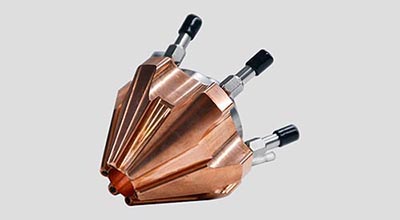
![New EHLA Nozzle]() New EHLA Nozzle
New EHLA NozzleThe inner and outer rings of the nozzle tip can be replaced as a whole without the need for manual adjustment, ensuring consistency of powder flow after replacement.
-
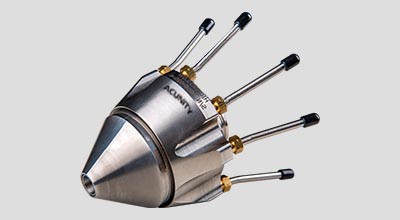
![Six-Beam High-Power Laser Nozzle]() Six-Beam High-Power Laser Nozzle
Six-Beam High-Power Laser NozzleEfficient water-cooled nozzle, suitable for high-power and long-term cladding needs
-
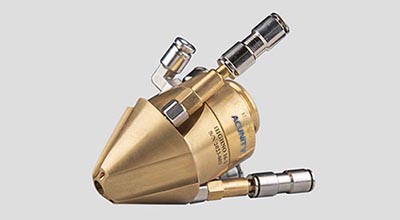
![Three-Beam High-Power Laser Nozzle]() Three-Beam High-Power Laser Nozzle
Three-Beam High-Power Laser NozzleEfficient nozzle, suitable for long-time cladding processing of some special processes

Inner Laser Cladding System
ACunity's newly launched inner cladding processing system boasts high integration, precision, and adaptability. It facilitates efficient and high-quality laser processing of the inner surfaces of various types of parts, achieving accessibility that traditional optical heads cannot. The system allows multiple processing applications such as internal hole cladding, repair, hardening, welding, and additive manufacturing. Depending on application requirements, different types of sensing systems can be equipped to ensure the stability of processing quality and enable real-time monitoring during the manufacturing process. Additionally, we customize special specifications of inner wall processing equipment for clients, which, when combined with ultra-high-speed laser cladding technology, can simultaneously process the inner and outer walls of products like hydraulic cylinders and columns.
By replacing the front nozzle, it can meet the processing requirements of laser cladding, repair, welding, hardening and quenching of different parts' inner walls and cavities. Due to limited visibility during the inner hole machining process, the machining head can be optionally equipped with a visual sensing and lighting system.
Immersion depth up to 4.5 meters
Inner laser cladding head, especially suitable for inner laser cladding
Cooling, laser, powder, and gas channels are tightly integrated into one pipeline, suitable for processing smaller and longer inner diameter parts
The modular structure of this design enhances adaptability and versatility
The minimum processing diameter is 33 millimeters
Significant weight reduction through the use of carbon fiber reinforced plastics (CFRP)
The depth can reach 4.5 meters, providing more comprehensive processing options
-13215855138.jpg)